
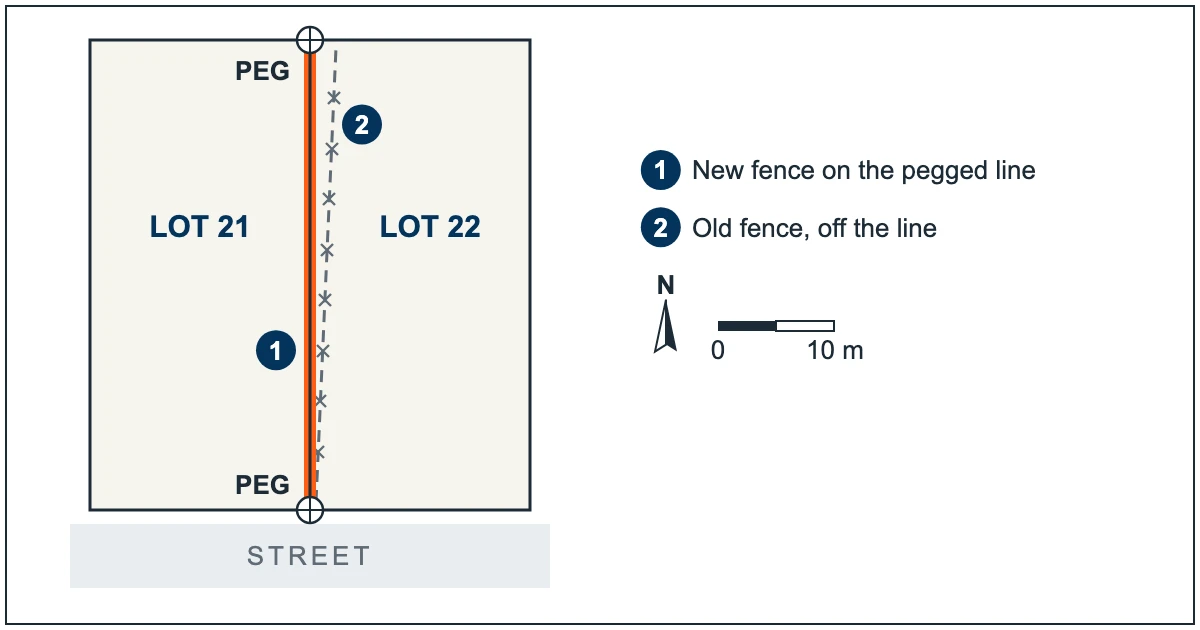
If you want to build or replace a fence with a neighbour in South Australia, the Fences Act 1975 sets the steps. You serve a written notice on your neighbour, they have 30 days to object, and then the work can go ahead. What the notice has to say about the fence's position is where problems often start. The notice sets out the length and position of the new fence, so the boundary should be settled before it goes in the post.
This guide walks through the process in order, shows where a boundary survey fits, and explains who pays. It is general information about South Australian law, not legal advice.
Key takeaways
- Under the Fences Act 1975 (SA), a new dividing fence starts with a notice in the Act's Form 1; replacement, repair or maintenance uses Form 2; a neighbour who objects replies with a cross-notice in Form 3.
- The notice must state the length and position of the proposed fence, so confirm the boundary before you serve it.
- Your neighbour has 30 days to object. If they do not, they are taken to have agreed and the work can start.
- The Act counts the cost of any survey reasonably required for the fence as part of the cost of the fencing work.
- Only a licensed surveyor can determine where a boundary is. Pegs on each end of the line give both neighbours the same answer before the fence goes up.
Listen to this article
Narrated summary (3 min 11 s). Open the transcript to follow along.
Show the transcript
The Fences Act process in one view
The Fences Act gives neighbours a simple, written process. Many fences are agreed informally, but following it protects your right to ask your neighbour to share the cost.
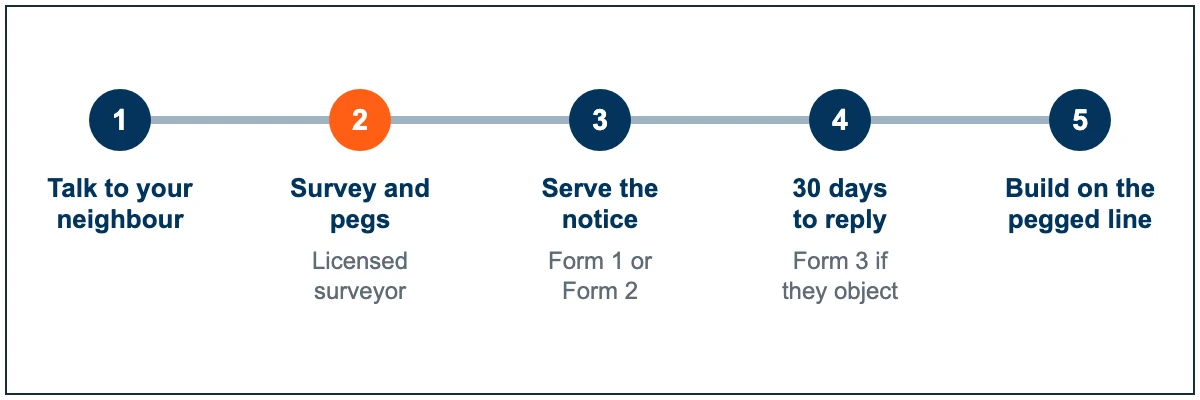
- Talk to your neighbour. Agree what kind of fence, where, and roughly what it will cost.
- Confirm the boundary. If there is any doubt about where the line is, have a licensed surveyor peg it now.
- Serve the notice. Use the Fences Act's Form 1 for a new fence or Form 2 for replacement, repair or maintenance. Serve it personally or by registered post.
- Wait 30 days. Your neighbour can object with a cross-notice in Form 3 within 30 days of service. They do not have to give reasons.
- Build, or resolve the objection. With no cross-notice, they are taken to have agreed and you can proceed. With one, you reach agreement on the proposals or the Magistrates Court decides.
| Form | Used for | Served by | Timing |
|---|---|---|---|
| Form 1 | Notice of a new dividing fence | The owner proposing the fence | 30 days, then build if no cross-notice |
| Form 2 | Notice of replacement, repair or maintenance | The owner proposing the work | 30 days, then build if no cross-notice |
| Form 3 | Cross-notice objecting or making counter-proposals | The neighbour who received the notice | Within 30 days of service |
The steps come from sections 5 to 8 of the Fences Act 1975 (current version, checked 10 November 2026). If you cannot find out who owns the land next door after reasonable inquiry, section 9 lets you fix the notice in a prominent place on that land instead.
Where the new fence should go
A dividing fence belongs on the legal boundary, which is not always where the old fence stood. The SA Government's guidance notes that many existing fences are not on the boundary, and that a fence's position does not change the boundary or who owns the land (SA Government, boundaries and fences).
That matters for the notice. Section 5 says a Fences Act notice for a new fence (Form 1) must state:
- the length and position of the proposed fence;
- what kind of fence it is;
- an estimate of the cost;
- the amount you are asking your neighbour to pay;
- if the proposed line runs into your neighbour's land, whether you will pay compensation for the strip they can no longer use, and how much;
- who will build it.
So the notice is a written proposal about where the fence goes. If that position is a guess based on the old fence, you are asking your neighbour to agree to something neither of you has checked.
The Act also stops an off-line fence from moving ownership over time. Section 17 says a dividing fence built away from the boundary, by agreement or court order, does not give either owner the other's land by adverse possession.
To find the legal boundary you need the title, the registered plan and, where the corners are not clearly marked, a survey. The SA Government is direct about the last step: a boundary's position "can only be determined by a licensed surveyor". If you are not sure where the corners are, have the boundary pegged before the notice goes out.
When to survey: before the notice
The cheapest time to settle the line is before anything is written down. Once a notice is served and a fence is built, fixing a position mistake means a new agreement, a court application or pulling the fence out. Section 12 lets the Magistrates Court decide the line of a fence and order removal of a fence that is not on the proper boundary.
A survey before the notice changes the conversation with your neighbour:
- Both of you see the same line. Pegs at each end of the boundary are hard to argue with.
- The notice is accurate. You can describe the length and position from the survey, not from memory.
- Compensation questions disappear. If the fence will sit on the boundary, there is no strip of land to compensate for.
- The fencing contractor builds to the pegs. They do not have to follow an old post line that may have drifted.
For example, picture a paling fence that has been replaced twice over 30 years, each time by following the old posts, so the line has drifted. Pegs placed before the notice show both owners where the new fence belongs, and the notice describes that line instead of the drifted one.
If the old fence is clearly on the line and both neighbours agree, a survey may not be needed. If either of you is unsure, if the old fence has been replaced before, if there is a retaining wall, or if a neighbour is building close to the line, survey first.
Planning a new boundary fence? Send us your address and a short note about the fence. Our licensed land surveyors will tell you which survey you need and quote it, free.
GET A FREE BOUNDARY SURVEY QUOTE CALL (08) 7110 0760
Rated 5.0 on Google from 17 reviews.
Who pays for the fence, and for the survey
Neighbours usually share the cost of a dividing fence, but the Act sets the rules more precisely than "half each".
Survey costs count as fencing costs. Section 4 of the Fences Act says the cost of fencing work includes "the cost of any survey that is reasonably required for the purposes of the fencing work". A survey needed to put the fence in the right place is part of the cost of the fencing work, so you can include it in the amount you propose to share.
Disputes are decided by benefit. If neighbours disagree about how to split the cost, section 12(6) says it is decided by the benefit each owner gets from the work, and equal benefit is presumed unless shown otherwise.
There is a cap for a better fence. If one owner wants a fence better than an adequate fence for the area, and the neighbours do not agree otherwise, section 12(7) limits the neighbour's share to half the minimum cost of an adequate fence. An adequate fence is one that meets the general standard of good fencing in the locality and suits the purposes of the neighbour being asked to contribute.
Follow the steps, or you may pay alone. Section 8 says no contribution is recoverable for work done before you are entitled to proceed, so do not start until the 30 days have passed or your neighbour has agreed in writing. Urgent repairs after damage are the exception under section 16.
What the survey gives you
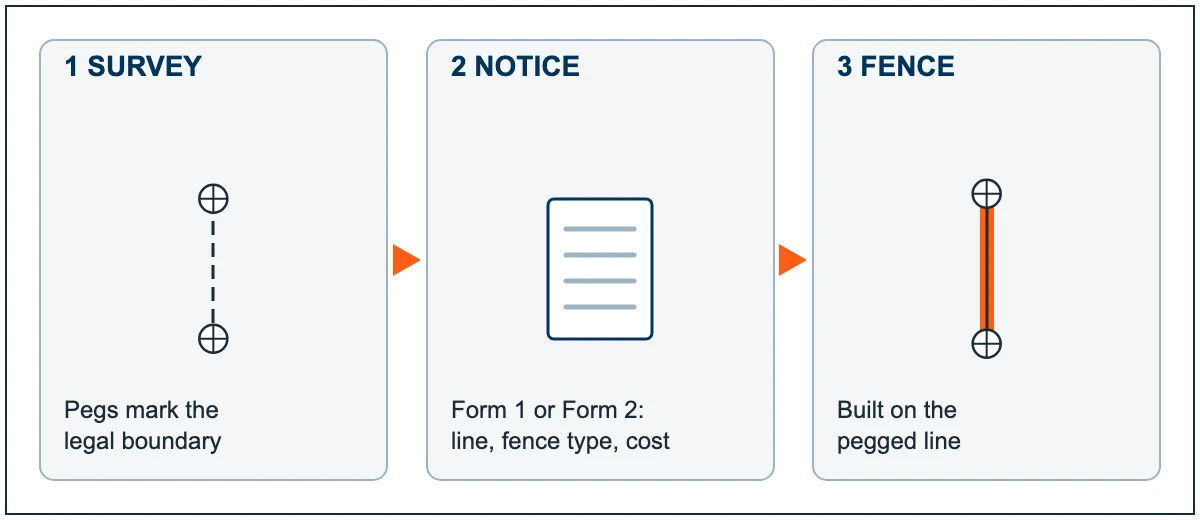
A boundary survey answers one question for both neighbours: where exactly is the line? A licensed surveyor checks the title and the registered plan, measures the land and the existing marks, and places pegs at the boundary corners. You can then describe the fence in your notice from those pegs, and the fencing contractor can build to them.
What if the pegs are disturbed? Under section 52 of the Survey Act 1992, interfering with a survey mark without the Surveyor-General's approval is an offence. There is a practical exception: a survey mark that is not a permanent survey mark can be disturbed in the course of building or maintaining a fence on the boundary that mark defines. Moving pegs for other reasons, without approval, generally is an offence.
What if there is a retaining wall or plinth? The Legal Services Commission's Law Handbook notes that an ordinary boundary fence is not likely to count as a structure under the Encroachments Act 1944 (SA). The Supreme Court of South Australia has, however, held that a fence, concrete plinth and retaining wall together were a structure for that Act ([2013] SASC 159). That matters because a structure that crosses the boundary can be an encroachment, which is dealt with under the Encroachments Act rather than the Fences Act. If a wall or footing is already there, we can check where it sits against the boundary.
Frequently asked questions
Do I need my neighbour's agreement to replace a boundary fence?
Not their signature, but you do need to give them the chance to object. Serve the Fences Act notice: Form 2 for replacement, repair or maintenance, or Form 1 for a new fence. If they do not serve a cross-notice within 30 days, they are taken to have agreed and you can proceed.
What happens if my neighbour objects?
They serve a cross-notice in Form 3 within 30 days, saying which proposals they object to and any counter-proposals. You can agree, or object to their counter-proposal within 30 days. If you cannot agree, either of you can apply to the Magistrates Court, which can decide the fence, its line and the cost split.
Does the new fence have to go where the old one was?
No. It should go on the legal boundary. Many old fences are slightly off the line, and the old position does not change the boundary. A boundary survey shows where the new fence should go.
Does my fence need council approval?
Most ordinary fences do not. Under Schedule 4 of the Planning, Development and Infrastructure (General) Regulations 2017, a fence up to 2.1 metres high, measured from the lower of the two finished ground levels, does not need development approval. The exclusion does not apply on a local or State heritage place, and State heritage areas have their own rules. The exceptions also include masonry fences over 1 metre, fences over 1 metre within 6 metres of a corner where two road boundaries meet (unless a 4 by 4 metre corner cut-off is kept), swimming pool safety fences, brush fences within 3 metres of a dwelling, and fences in some flood and historic area overlays. A retaining wall holding back more than 1 metre of soil is not covered by this exclusion and may need approval. If you are unsure, check with your council before you build.
How much does the survey cost?
Our guide for standard residential surveys is $800 to $3,500. The price depends on the type of survey and the size and complexity of the land. Send us the address for a free quote.
What if I cannot find out who owns the land next door?
After reasonable inquiry, section 9 of the Fences Act lets you fix the Form 1 notice in a prominent place on that land. If no cross-notice is served, you can proceed as if the owner had agreed. You can also apply to the Magistrates Court for a decision.
Before you serve the notice
- Talk to your neighbour first.
- If there is any doubt about the line, get the boundary pegged by a licensed surveyor.
- Describe the fence's length and position in the notice from the pegs.
- Wait the full 30 days, or get written agreement, before work starts.
- Keep copies of the notice, proof of service and any agreement.
City Surveyors Adelaide provides boundary surveys across Adelaide.
Get the line right before the fence goes up. Tell us the address and what the fence job is. We will tell you which survey you need and send a free quote.
GET A FREE BOUNDARY SURVEY QUOTE CALL (08) 7110 0760
Rated 5.0 on Google from 17 reviews. More about our residential surveying work.
Sources checked 10 November 2026: Fences Act 1975 (SA), Survey Act 1992 (SA), Encroachments Act 1944 (SA) and Planning, Development and Infrastructure (General) Regulations 2017 (SA) on legislation.sa.gov.au; SA Government, boundaries and fences; Legal Services Commission of SA, Law Handbook. General information only, not legal advice.